

2012 Honda Gold Wing


2012 Honda Gold Wing Review
The Gold Wing is a legend in motorcycle circles, known for its comfort and long-distance prowess, and although I never really had a huge desire to ride something as big as a Gold Wing, I can certainly see its appeal for the touring crowd. If I have the time, I prefer long hours in the saddle covering many kilometres in a day. My bike of choice for these types of rides is a large, well-planted bike that doesn’t get tossed around too much by either crosswind or headwind. I consider the Kawasaki Vaquero, Victory Cross Country or any of the Harley-Davidson touring bikes about as big as one really needs, and I have always thought of the Gold Wing as too bulky and awkward to manoeuvre, akin to trying to dock the Queen Mary at your local marina. But earlier this spring, I was looking at a ride that would consist of 16,000 km and 27 days, and I admit, I was looking forward to putting the Wing through its paces. I wondered if it would change my mind about its size.
After all, the Wing has been at the top of the list the world over as the long-distance touring machine, and with a production run of 35 years and counting, it has stood the test of time, proving itself over and over.
As it turns out, there isn’t a 2011 Gold Wing, as the ultimate luxury cross-country high-miler’s production line moved from Ohio to Japan, and in order to facilitate the move, production was increased for the 2010 model to tide things over until the Wing started production in Japan with the 2012 model.
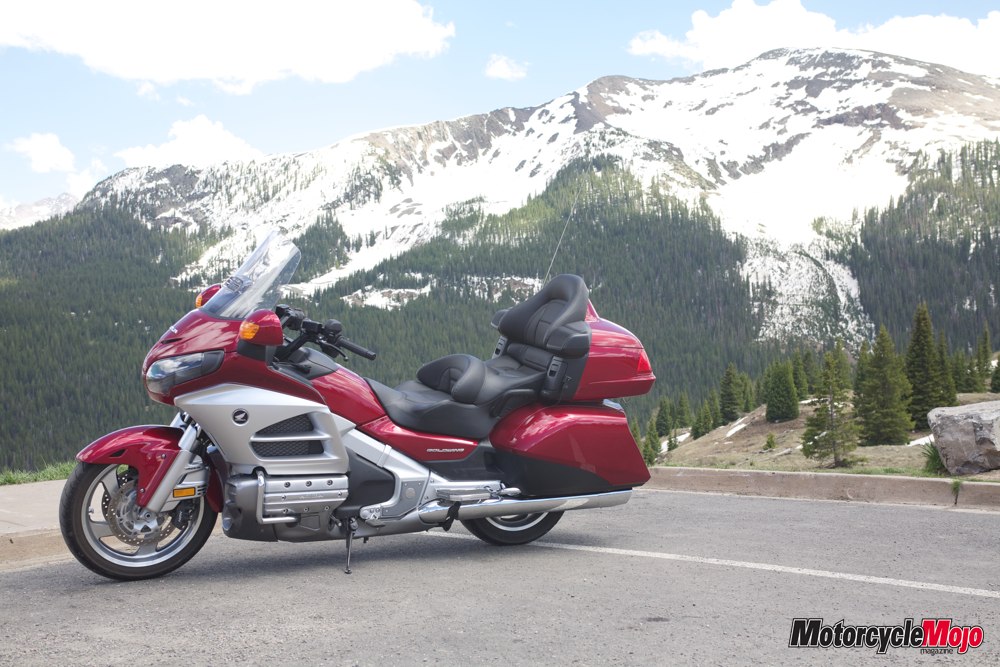
With only minor upgrades to the engine, the driveline on the 2012 Wing has remained virtually the same as the 2010 model, but the body work has been redesigned for 2012. The new body style is more fluid, with flowing lines that follow through from front to back, and I dare say it has a sportier look to it, if it’s at all possible for the biggest bike on the road to look sporty. The fit and finish, in true Honda style, is immaculate.
Something that hasn’t changed is the interaction with a Gold Wing. The Wing has always been known for its array of buttons, whether on the switchgear or on the console, likened many times by those who view them to the cockpit of an aircraft. Sitting on the bike with a plethora of buttons and switches can be a little intimidating, at least until you ride one for a while.
Beginning at the left switchgear, your hand has to go into contortions to reach the array of buttons. At the top are CB and intercom buttons. Directly below those are the standard high- and low-beam switch, horn and turn-signals button. Continuing south is stereo volume, channel select and mute buttons, and below those is a single button that allows the rider to zoom in and out and activate voice commands on the built-in GPS.
The right switchgear is similar to any other touring bike with a kill switch, starter button and electronic cruise control buttons. The difference is that the Gold Wing has a reverse gear button beside the starter switch. When the bike is running and the transmission is in neutral, simply push the reverse button, and once activated, as evident by a dash light, hitting the starter button will reverse the bike in a slow, controlled manner. A nice touch if you park on the wrong side of a grade. At 417 kg (919 lb.) full of gas and ready to ride, the Wing is not easy to manhandle, and the reverse gear worked very well; it got me out of a bind when my front tire found a pothole, eliminating the embarrassing need to ask a bystander for a push.
On the left side of the console are audio controls, some of which duplicate the left switchgear buttons. The updated stereo on the Wing provides a healthy bit of volume and with the help of the big windscreen, delivers crisp, clean sound at any speed. The stereo is iPod and MP3 friendly by plugging into the 8 mm jack for aux input to the stereo in the left-hand console storage compartment, but connecting an iPod to the USB connection that resides in the trunk will allow you to control an iPod from the left switchgear buttons.
The console controls continue front and centre with heated grips, the rider’s heated seat and digital display options, while the right-side console controls govern the GPS, height of the headlight beam and suspension adjustment. None of the right-hand console controls can be used while the bike is in motion for fear, I suppose, of taking your right hand away from the front brake lever. I can understand this for the GPS, as it takes time and concentration to operate but, in my opinion, adjusting the headlight height and rear suspension preload would be better done while the bike is in motion instead of stopping, adjusting and getting underway again, only to find that a setting isn’t correct and having to repeat the process. On the plus side, the suspension does have two memory presets to aid in quickly selecting suspension settings for particular riding conditions.
| MODEL | 2012 Honda Gold Wing |
| List Price | $29,999 |
| Warranty | 3 years – unlimited distance – transferable |
| Engine Type | Liquid-cooled, horizontally opposed six-cylinder |
| Displacement | 1832 cc |
| Power (claimed) | |
| Torque (claimed) | |
| Bore and Stroke | 74 mm x 71 mm |
| Compression Ratio | 9.8:1 |
| Fuel Delivery | PGM-FI electronic fuel injection |
| Transmission | Five-speed including overdrive, plus electric reverse |
| Final Drive Type | Shaft |
| Front Suspension | 45 mm cartridge fork with anti-dive system |
| Rear Suspension | Pro-Arm single-sided swingarm with Pro-Link single shock with computer-controlled spring preload adjustment and two memory presets |
| Wheel Travel | Front: 122 mm (4.8 in.), Rear: 105 mm (4.1 in.) travel |
| Brakes | Front 296 mm discs with three-piston calipers; rear single 316 mm disc with three-piston caliper. Dual-Combined Braking System with ABS |
| Wheelbase | 1690 mm (66.5 in.) |
| Rake and Trail | |
| Tires | 130/70R-18 radial front; 180/60R-16 radial rear |
| Weight (wet) | 417 kg (919 lb.) – full tank of fuel, ready to ride |
| Seat Height | 740 mm (29.1 in.) |
| Fuel Capacity | 25 litres |
| Fuel Economy (observed) | Average 5.8 L/100 km |
| Fuel Range (estimated) | 431 km (based on average consumption) |
The analog instruments consist of the speedometer in the centre, flanked by a tach on the left and fuel and temperature gauges on the right. All numbers are white on black backgrounds, making them easy to read. The built-in GPS screen, however, is at an angle to the rider, and in daylight, consistently has glare from the sky on the screen. I had to slouch to see the whole screen clearly. A shorter rider of about 200 cm (5 ft. 8 in.) should be fine.
The improved navigation system uses a faster GPS receiver and offers a new 3D view of the landscape and also lane guidance, a nice feature when traversing multi-lane highway interchanges and cities. Route sharing is also a new characteristic that allows the GPS to import or export navigation settings from your home computer or another Wing, so you can share your route with fellow travellers via SD card.
I do have a gripe with the GPS. Maybe it’s the way it was set up, or possibly human error, but I’m blaming it on the GPS. I was approaching Phoenix, Arizona (geographically speaking, the sixth largest city in the United States), from the western edge to visit friends in Apache Junction, which is on the far eastern side of the city. Instead of taking me on one of the highways that skirt the city, it took me directly through it. AAARRRGGGHHH.
The Gold Wing is known for many things, and weather protection is one of them. The redesigned bodywork does an incredible job of protecting the lower body and legs. I really appreciated the weather protection as I began my 16,000 km (10,000 mi.) test ride in cold damp weather, a scenario that would play itself out over and over again as the days rolled by – sometimes starting the day at 5°C (41°F) in rain and only warming up slightly as afternoon wore into evening. I rode in elevations so high that once, I passed snowmobilers enjoying fresh snow as it fell upon us. I certainly began to appreciate the creature comforts of the Gold Wing after putting on more than a thousand kilometres per day for three days straight in cold, wet weather.
Aiding the rider’s comfort are five-position heated grips and heated seat – front and rear seat and backrest are individually controlled – and vents that, when open, allow engine heat to be diverted to the rider’s feet, the control of which is conveniently located on the left console. I expect those same vents might also protect the feet from some road spray. I was riding with my daughter on her naked bike for part of this trip, and I told her I didn’t have any of the heated amenities on as a gesture of solidarity with her, since she was freezing. She probably won’t read this, so that can be our little secret. After all, I had to test it, right?
The large windshield is moveable about 100 mm (4 in.) by releasing archaic clamps at each side of the fairing and wiggling the windscreen up and down. Like the right-hand console switches, you must stop the bike to adjust the windscreen, something that is better done while moving to find the best position. Unfortunately, Honda did not add a power windshield on the new model, citing the fact that no one asked for it. Their literature says it saves weight by not having an electric motor, but really, what’s another kilogram thrown into the 417 kg mix?
All of this wind protection can be a godsend in poor weather, but can become a disadvantage in very hot conditions, as the rider strives to find a cooling breeze. There is a large vent in the centre of the windscreen that is quite effective at directing air at you, at least initially, but once you get used to its effects, you don’t really notice it anymore. I prefer always to ride with protective gear, and while riding in the extreme heat of Nevada, Utah and Arizona, I found the lack of wind and the resulting heat stifling.
The redesigned bodywork equates to 154 litres of storage space. I began to wonder just how much that is; after all, it’s hard to image how much space 308 half-litre water bottles might take up. With that in mind, I was looking forward to seeing just how much stuff I could take with me. Like any long trip, the pile of bits and pieces you think you might need continues to grow until you realize you’re out of touch with reality – then the pile gets whittled down to just the necessities plus a few extras.
The claim of 154 litres includes molding cavities and corners that the CAD files say exist, but these little nooks and crannies really don’t amount to useable space. When packing, I was a little disappointed in the storage area, partly because the panniers and the trunk openings are smaller than the available space inside, and therefore didn’t allow for one large bag to be used. My disappointment came to an end when I returned home and unloaded everything into a pile on my garage floor. With so many small items shoved in corners here and there, I didn’t realize just how much stuff I had packed. I realized then that not only does 154 litres sound like a lot – it really is a very significant amount of storage space. The panniers and trunk are provided with a remote-controlled key-lock for quick locking and unlocking without fumbling with a key.
Rider and passenger comfort is second to none. Rider ergonomics are ideal, as the long handlebar pulls back to meet the rider and your feet rest comfortably below the thighs, providing an upright ride that keeps the lower back and pelvis in a neutral, stress-free position. Featuring a generous, wraparound lower-back support, the flat seat hovers above the ground at 740 mm (29.1 in.), making it easy for my 178 cm (5 ft. 10 in.) frame to touch solid ground. Not once in 27 days of continuous riding did I feel uncomfortable or sense the need to get off and rest my gluteus maximus.
Honda has spent considerable resources refining the passenger area, as Gwen can attest. She flew into Las Vegas to meet me and rode with me for the last ten days of my trip, never complaining once about her perch while riding pillion. In fact, in between the few times she nodded off, she continuously raved about how comfortable the seat and riding position was.
As you would expect from this iconic touring machine, the Gold Wing’s suspension was plush on the highway but handled itself extremely well in the twisties. The 45 mm front fork has revised internals, and along with the Pro-link rear shock and single-sided swingarm, provided a ride that was soft but always held its composure regardless of road surface. Even on the some of the roughest roads I encountered, it never even hinted at bottoming out. The worst route was a 30 km stretch of hard-packed gravel that the construction company seemed to have forgotten about, and repeated pounding from trucks of all sizes had turned the highway into thousands of potholes that were impossible to miss.
In the hundreds, if not thousands, of sweepers and hairpin turns that I encountered during my travels in the Rocky Mountains of British Columbia and Colorado, and then carving the canyons of Utah, Nevada and Arizona (it’s not all desert), the new OEM Bridgestone Exedra tires mounted on the cast-aluminum wheels held fast to the road and, once again, the suspension kept its cool. The Gold Wing has not only been known for its prowess on the open road, but also on the twisty bits; now with the redesigned bodywork, it has more advanced aerodynamics and pressure equalization vents that exit the tail section for less wind resistance. Now, having experienced it for myself, I can honestly say that this bike handles like a really big sportbike. Dragging the foot peg feelers on many corners, the suspension stayed true and the tires gave good feedback; I never once felt a slide while tipped far over into a corner.
Riding the Wing on gravel is a different story. The hard-packed construction was one thing, but I once ran out of pavement, finding myself on a road with loose gravel. I’m a pretty confident rider on gravel and have never turned away from it, but when riding a bike that begins the day at over 400 kg plus luggage and rider, it pretty much goes where it wants to. Lets just say I was glad to find pavement again.
Just as the suspension provides confidence, the brakes offer identical assurance in a panic situation. In normal braking, an easy two-finger pull on the adjustable front brake lever is all that’s needed to operate the multi-piston front and rear calipers, but in more intense scenarios that I happened to be involved in (a couple of too-close-for-comfort deer encounters), hauling on the binders stopped the Wing in very short order. With Honda’s Dual Combined Braking System, the front brake lever actuates some pistons in the rear brakes, while the rear brake pedal actuates some pistons in the front brakes. In conjunction with their electronically controlled ABS, the braking system is very safe and easily slows this big bike down in a hurry.
One of the above-mentioned deer encounters was at night, on a wet road, in utter blackness. With two 55-watt low-beam bulbs and a pair of 55-watt high-beam bulbs (all four bulbs work when high-beam is selected), the Gold Wing really lights up the night and made it possible for me to see the deer in time to avoid a potential disaster. During that stint of controlled panic braking, I did feel the unobtrusive ABS kick in on the wet tarmac and thanked my lucky stars. It could have been really bad without anti-lock brakes.
Getting the fully loaded Gold Wing up to speed was an easy task for the 1800 cc, six-cylinder engine, just twist and go. Even in fifth gear at low rpm, the engine had plenty of torque to pass slower vehicles without having to downshift, although one or two downward prods just make the exercise much more fun. The engine is turbine smooth, and I felt no vibration throughout the rev range right up to the 6000 rpm redline. Before exhaust gasses are dispersed into the atmosphere from the whisper-quiet mufflers, they pass through catalytic converters that ensure engine emissions will pass California CARB regulations, North America’s toughest air-quality standards.
The overdrive five-speed transmission was quiet and shifted smoothly in all gears, but required a sturdy prod from first to second, sometimes selecting neutral if that first shift wasn’t firm enough. The five-speed gearbox ratios are ideal for all-around riding, and the overdrive fifth produces an economical low rpm at our highway speeds, but there were a few times I inadvertently reached for a sixth gear while on high-speed interstates. Final drive to the 180/60-16 rear tire is via drive shaft. The hydraulic clutch lever is adjustable and the friction point is very predictable, and combined with the torquey engine, taking off from a stop is smooth and quick.
Honda is a very progressive company, but I feel the Wing could be a little more advanced for today’s market. The lack of a power windshield on a top-of-the-line touring bike is a bit outdated these days. The Wing also lacks simple but useful features like average and instant fuel consumption and distance-to-empty calculations.
While those are fairly minor complaints, the Wing is still one of the best touring bikes in the world and has so much going for it. It would be nice to see a few more updates like those mentioned above to Honda’s flagship motorcycle.
I admit that I was a little Jekyll-and-Hyde about taking the Gold Wing, because of its size on the one hand, but also knowing that it was a perfect bike for my trip on the other. So, did my thoughts on the Gold Wing change after living on it for 27 days and 16,000 km, through all types of road conditions and all four seasons?
I must say that the Wing is an ideal bike for all types of highway use, whether straight lines or any degree of corners. I did find it cumbersome in the city; it is a big bike, period, that is without debate. If I was fatigued at all, I would have to concentrate on making graceful, well–balanced stops at intersections when the bike was fully loaded.
Considering this bike is made for the long haul and the weather protection is unbelievable, I really did enjoy riding it for the time I had it and wouldn’t hesitate to take it again on a long trip. Everything about it worked flawlessly while surrounding me in comfort and luxury. And who doesn’t need a little comfort and luxury once in a while?
All those amenities come with a hefty price tag, though. The base model I rode starts at $29,999, while the airbag model retails for $30,999. For more information, go to your local dealer or check out www.honda.ca.





Thanks for Reading
If you don’t already subscribe to Motorcycle Mojo we ask that you seriously think about it. We are Canada’s last mainstream motorcycle magazine that continuously provides a print and digital issue on a regular basis.
We offer exclusive content created by riders, for riders.
Our editorial staff consists of experienced industry veterans that produce trusted and respected coverage for readers from every walk of life.
Motorcycle Mojo Magazine is an award winning publication that provides premium content guaranteed to be of interest to every motorcycle enthusiast. Whether you prefer cruisers or adventure-touring, vintage or the latest models; riding round the world or just to work, Motorcycle Mojo covers every aspect of the motorcycle experience. Each issue of Motorcycle Mojo contains tests of new models, feature travel stories, compelling human interest articles, technical exposés, product reviews, as well as unique perspectives by regular columnists on safety or just everyday situations that may be stressful at the time but turn into fabulous campfire stories.
Thanks for considering a subscription. The Mojo team truly appreciates it.
