

Ducati GT1000



Top of mind for Mojo editor Roberts and I was choosing the right bikes for our fall trip to the Smoky Mountains in the southeastern U.S. this past fall.
Getting to motorcycle Mecca in reasonable comfort was of some concern as there are over 1,200 km of boring highway between us and our first stop at the Wheels Through Time Museum in Maggie Valley, North Carolina. On the other side of the ledger was the need for a bike with sporting credentials that would allow a spirited romp up the famous ‘Dragon’ (Hwy 129) at Deal’s Gap.
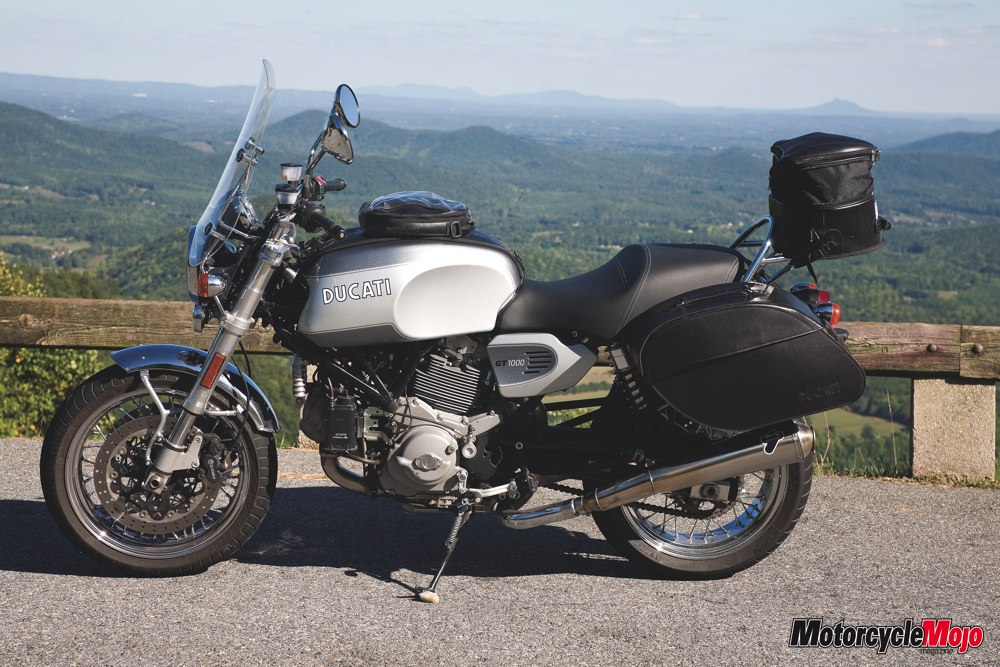
The classification of ‘Sport Touring’ covers much ground these days, but I preferred to stay away from the junior luxobarges that occupy part of this category. With some of the more plush examples crushing the scales to the tune of 317 kg (700 lbs), I opted for something more basic. Light and agile was what I needed, something with just a nod toward long distance comfort. The 2008 Ducati SportClassic GT 1000, weighing in at a nimble 185 kg (408 lbs) dry, looked like the ticket as optioned from Ducati’s own accessory catalogue with minimalist touring garb.
Picking the GT up from Ducati the day before we were to leave didn’t give much time to get acquainted, but there she sat togged up with optional ‘Comfort Seat’, leather saddle bags, rear luggage rack, expandable tail pack, tank protector with small magnetic bag and a medium sized clear plastic windscreen (Ducati offers the 2009 GT 1000 ‘Touring’, available with windscreen and luggage rack as standard). Not looking like a continent crosser, nor focused sportbike, she appeared to be a versatile ‘does it all’ road bike in the 70’s mould that befit her pseudo-retro styling.
At first inspection, I appreciate the Ducati GT 1000’s purposeful styling, but more attention to details would make for a better overall package. The routing of lines and cables in the engine area looks somewhat untidy and the evaporative canister hanging on the left side of the front cylinder does nothing to help appearances. In particular though, I found the highflying rear fender odd looking. Perhaps it would benefit in an appearance (if not performance) sense with a larger rear wheel as it’s styling inspiration, the 1971 750 GT, sported to fill the space, as opposed to the modern 17-incher.
Digging deeper, the handling credentials of the GT were confirmed as it shares frame and suspension components (save higher spec rear shocks) with its beautifully styled brother, the Sport 1000 S. On the other hand, some might consider the 992 cc air/oil cooled 2-valve Desmodromic V-twin powerplant somewhat low tech. With the on-going power race seeing some sport bikes boast close to 200 horsepower, how could the GT’s claimed 92 hp at 8,000 rpm and 67 ft/lb of torque at 6,000 rpm keep one awake let alone excited? Quite well, as it turns out.
I have enjoyed the power delivery of this torque-rich motor since first trying it in the Multistrada 1000, and have yet to find it wanting on the street. The wide spread of power means that finding the ‘right’ gear in the 6-speed box for rapid exit of a corner often meant that you had the choice of at least a couple of cogs. Passing power on the highway is also readily available with little or no downshifting required. The GT benefits greatly from the implementation of a wet clutch (vs. dry in the earlier Multistrada), making for a lighter pull and wide engagement.
Starting the Duc up the first time, I got an earful of one option that I hadn’t thought to request and that was the Termignoni exhaust. The growl from the barely baffled Termignonis was certainly enough to ensure conspicuity. These mufflers, which are humourously referred to as ‘silencers’ in Ducati literature, are no where near as obnoxious as ‘straight through’ pipes, but were loud enough to quicken the pulse of unsuspecting bystanders upon startup. One afternoon at the Deals Gap Motorcycle Resort, I fired up the GT with a quarter throttle in hand and she snapped to with a bark of authority. A neighbour strode over laughing and saying that he had jumped half out of his skin, but commented that he loved the rich sound. Me too. I would certainly pony up for a set if it were my bike.
When it came to packing, the available 30-litres of space between side bags and tail pack would best categorize the bike as ‘light touring’. My wife had a good laugh at what she considered meagre luggage capacity.
I, however, found that as a regular guy it had enough room to carry what I needed for eight–days insofar as occasional changes of clothing and rain gear.
Leaving later than we wanted on our first day, Glenn and I kept a brisk pace on the highway and found the Ducati to be a good running companion to his Buell Ulysses XT. During this slog of the trip, I was delighted to find that the GT 1000 far exceeded expectations in the comfort department. When combined with the short reach to the medium rise tubular bars, the fairly upright position didn’t put excessive pressure on the wrists, and the slight forward lean meant that I didn’t put too much weight on my rump. Speaking of which, the optional Comfort Seat lived up to its name. The wide and flat surface in combination with the un-cramped ergonomics provided many hours of comfortable saddle time. In one case, a 12-hour highway stint left me feeling moderately shagged, but my rear had no complaints.
On day two, more modest speeds found us droning down the highway with the tach reading 4,100 rpm on the 70 mph highway. At this speed the windshield proved to be quite effective at diverting the windblast away from my body but allowed some turbulent wind at helmet level leading to minor buffeting and increased noise. The wind noise in combination with the thudding beat from the exhaust led me to use earplugs on the boring portions of the trip.
In the last two hours of the second day, we ran into the remains of Hurricane Kyle. I opted not to put on my rain gear in the hopes that this was just a quick patch of rain like we had encountered earlier in the afternoon. This turned out to be a bad plan as the rain came hard and the windscreen did little to keep me from getting soaked through in no time flat. The luggage faired well though, with no moisture getting through the saddlebags nor through the tail pack’s rain cover. On the other hand, plastic bagging the contents of the tank bag proved to be the right choice as water did make its way through the zipper.
Fuel range was quite comparable for both the Ducati and the Buell as we found ourselves hitting reserve within a few kilometres of each other. The GT averaged 5.26 L / 100 km (53.7 mpg) giving a potential 285 km from the 15-litre tank. On a side note, I found that the GT’s claimed dry weight of 185 kg (407 lb before accessories) to be well-balanced and quite manageable to push as I did for several miles after drying out the tank one night on a dark side road. When reserve is reached, a yellow warning light comes on and the trip meter starts counting up to show the distance covered since that point. I was quite disappointed to find myself on the side of the road with the trip meter showing only 28. I forgot to take into account that I was on a U.S. bike and those 28 were miles, which translates into a more understandable 45 km. The rest of the instrumentation is quite complete with easily read ‘needle’ type speedo and tach, along with the usual array of warning lights plus clock. Switchgear is also conventional, easy to use and reliable.
Having made it through the flat and straight portion of the trip, Glenn and I found ourselves among some of the most exciting and fabled motorcycling roads in North America. Now it was time to see if the GT 1000 would live up to my expectations in the corners. Again I wasn’t let down. The very capable suspension consisting of 43 mm inverted forks with 120 mm (4.7 in) of travel and the twin, preload adjustable rear shocks with 133 mm (5.2 in) of travel seemed to be set perfectly for my 84 kg (185 lb) weight. The ride is sporty-firm, but even good-sized bumps were easily swallowed, and when all tied together with Ducati’s stiff tubular steel trellis frame, handling is light and composed. Whether the corners were tight switchbacks or fast smooth sweepers, control through the Duc’s wide handlebar was confidence inspiring with no head shaking antics experienced, even upon encountering mid-corner bumps.
Don’t let the classic good looks of the chrome spoke wheels fool you. The 17-inch rims easily accept current sport rubber with 120/70 front and 180/55 rear Michelin Pilot Classics. Michelin classifies these tires as ‘sport/touring’ which nicely complements the GT’s multi-purpose nature providing touring range, and when asked, a high level of cornering capability. I found it a joy to push the Duc in the corners and was happy to find that the tires gripped reassuringly right to the very edge. Even with the kickstand kissing the pavement, the Michelins showed no sign of giving up their grip on the road. Equally comforting was how the tires shrugged off rain on the soaked mountain road that we had encountered earlier in the trip.
At a steady throttle setting, the motor thrums along nicely, sending out enough vibration to let the rider know that there are things mechanical going on below, but not so much as to be annoying. Hard acceleration from low rpm in the upper three gears while vigorous, finds one in a band of strong vibration that extends up to 4000 rpm. The sensation, while short of volcanic in nature, leaves no doubt that there are large pistons swinging around down there producing good power. A quick down prod of the light-shifting gearbox got me past that range and netted even more robust acceleration.
The very crisp response of the Marelli EFI with 45 mm throttle bodies rewards a smooth hand so I was at a disadvantage to start. I found that in unfamiliar, tight cornering situations, small changes in throttle setting produced a jerky on-or-off feel making it difficult to hold a steady line. With practice and improved confidence, smooth cornering arcs resulted.
When called on, the 2–piston calipers, twin 320 mm front discs and 245 mm rotor and single piston rear system offered good feel and stopping power. This set up isn’t at the level experienced earlier this year with the Ducati 696’s awesome 4-piston radial mounted front system, but they are a powerful and very effective set up for the road. Panicked applications of the brake system proved it to be up to the challenge when collisions on the Blue Ridge Parkway were neatly avoided with numerous deer that seemed bent on mutual destruction.
Back on the superslab and heading home with eight-days and over 4,000 km under our belts, I came to fully appreciate how Ducati’s SportClassic GT 1000 strikes a damn near perfect balance of sport and light touring capabilities. Those looking for a bike that combines light weight, confidence inspiring handling, flexible power delivery topped with a generous scoop of comfort would be well advised to take a hard look at the GT 1000. MMM
Go to www.ducati.com for more information.





Thanks for Reading
If you don’t already subscribe to Motorcycle Mojo we ask that you seriously think about it. We are Canada’s last mainstream motorcycle magazine that continuously provides a print and digital issue on a regular basis.
We offer exclusive content created by riders, for riders.
Our editorial staff consists of experienced industry veterans that produce trusted and respected coverage for readers from every walk of life.
Motorcycle Mojo Magazine is an award winning publication that provides premium content guaranteed to be of interest to every motorcycle enthusiast. Whether you prefer cruisers or adventure-touring, vintage or the latest models; riding round the world or just to work, Motorcycle Mojo covers every aspect of the motorcycle experience. Each issue of Motorcycle Mojo contains tests of new models, feature travel stories, compelling human interest articles, technical exposés, product reviews, as well as unique perspectives by regular columnists on safety or just everyday situations that may be stressful at the time but turn into fabulous campfire stories.
Thanks for considering a subscription. The Mojo team truly appreciates it.
